
Pinched nerve · Olathe, Kansas
Nonsurgical Treatment for Pinched Nerves
Arm or leg pain that comes from your spine can be treated without surgery.
A pinched nerve has a specific level and a specific cause. The evaluation finds both and tells you whether nonsurgical treatment is appropriate.
- For nerve pain that has not settled with rest, medication or therapy
- Nonsurgical treatment directed at the neck or the low back
- Candidacy answered at the first visit
- Refunded in full if you are not a candidate
- 25 years in practice
- 65,000+ treatment visits supervised
- 5.0 on Google · 60 reviews
Sound familiar?
Does this sound like your pinched nerve?
Typing, driving and looking down at a phone aggravate a pinched nerve in the neck. Sitting, bending and standing up from a chair aggravate one in the back. Sleep suffers because there is no position that quiets the arm or leg for long.
- Burning or electric pain running into an arm or a leg
- Numbness or tingling in a specific patch
- A weak grip, a heavy arm or a foot that catches
- Looking down at a phone or sitting for long makes it worse
- You have been told it is a pinched nerve but not what to do about it
Common symptoms of pinched nerve
- Sharp, burning or electric pain that travels into an arm or a leg
- Numbness, tingling or a "dead" patch of skin in a specific area
- Weakness — a weak grip, a dropped foot, trouble lifting the arm
- Neck or back pain that is milder than the limb pain
- Symptoms that change with head or trunk position
If two or more of these are true, an evaluation is the logical next step. It is the only way to know what is contributing to your symptoms and whether nonsurgical treatment is appropriate.
What pinched nerve is
What pinched nerve is, and why it keeps coming back
Nerve roots leave the spinal canal through small openings between the vertebrae. A herniated disc, a bulging disc, a bone spur or a narrowed opening can crowd that space. The nerve responds with pain along its path, altered sensation, and sometimes weakness in the muscles it supplies. The symptoms are felt far from the spine, which is why arm or leg pain is often the main complaint.
Between each pair of vertebrae sits a disc. When it's healthy, it's tall and full of fluid, and it holds open the space where a nerve leaves your spine.
Years of sitting, lifting and gravity compress it. It loses water and height, that space narrows, and the nerve gets crowded. That's what sends pain, numbness and tingling down a leg or an arm.
It doesn't fix itself, because discs have no blood supply. They depend on pressure changing as you move — and a compressed disc isn't getting that.
How we treat it
Our treatment gently separates the vertebrae, taking pressure off the disc and giving the nerve room. Repeated over a course of care, that's what gives symptoms a chance to settle.
Pinched Nerve treatment options
Most of the usual approaches manage the symptom. Fewer address the load on the disc.
None of these are wrong, and some of them may be part of your care. The question the evaluation answers is whether something is still loading the disc or the nerve — and whether that is something we can change.
Nonsurgical treatment options for pinched nerve
- Posture and load changes specific to the nerve involved
- Physical therapy including nerve glides and strengthening
- Anti-inflammatory medication or a targeted injection, prescribed by a physician
- Our nonsurgical treatment, directed at the neck or the low back, which takes pressure off the disc and the nerve
- Surgical consultation when weakness is progressing or when a proper nonsurgical course has not helped
| Usual approach | What it does |
|---|---|
| Rest and ice | Reduces inflammation for a while. Does not change what is loading the disc. |
| Pain medication | Blocks the pain signal. Useful; does not address the source. |
| Injections | Reduces inflammation around the nerve, often temporarily. |
| Physical therapy | Strengthens the muscles that support the spine — valuable, and sometimes not enough on its own when a disc is the driver. |
| Surgery | Removes or fuses tissue. Sometimes necessary. A large step to take before nonsurgical options have been properly evaluated. |
Our approach
Evaluate first. Then treat, measure and adjust.
We focus on nonsurgical treatment for appropriate spine, disc and nerve conditions. Treatment begins with an evaluation so we can determine whether our approach is appropriate for your condition.
- 01
Evaluate
Determine what may be contributing to your symptoms.
- 02
Treat
Begin appropriate nonsurgical treatment if you are a candidate.
- 03
Measure
Track your response to treatment.
- 04
Adjust
Modify the approach based on how you respond.
Why evaluation matters for pinched nerve
Two people with "a pinched nerve" can have completely different problems — one a soft disc herniation that responds well to unloading, the other a bony narrowing that behaves differently. The nerve level matters too. An evaluation identifies which root is involved and what is compressing it, which is what determines the appropriate treatment.
How we evaluate pinched nerve
We test strength, reflexes and sensation to identify the nerve level, use specific positional tests to confirm the spine is the source, and review your imaging if you have it. When the findings agree and the compression is one our approach is suited to, we explain the treatment and the measures we will track. When they do not, we say so.
When additional medical evaluation is necessary. Rapidly progressing weakness, numbness on both sides, trouble with balance or walking, or any bowel or bladder change needs same-day medical evaluation.
What a treatment visit is like
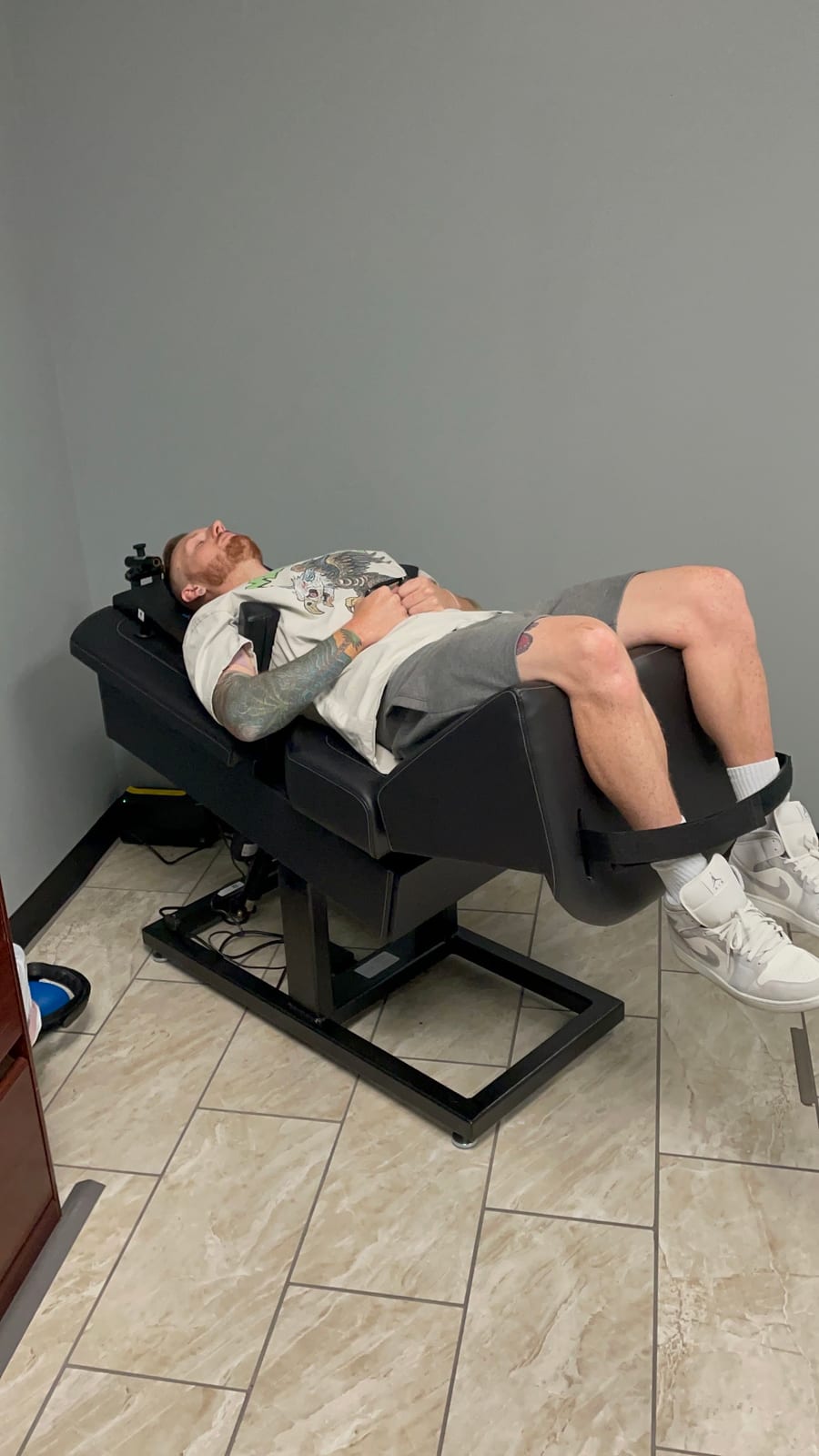
Nonsurgical — no injections, no incisions. You are seated and reclined, not face-down and not in a harness. Treatment can be directed at the low back or the neck, the settings are set for you, and a visit is short. Whether it is appropriate for you is decided at the evaluation.
Honest about who it's for
It is not for everyone, and no one can promise you an outcome before examining you. For the right patient it takes the load off a painful disc without surgery, and we measure your response rather than assume it. The evaluation is how we find out whether you are that patient.
The first step
Start with an evaluation.
Evaluation + 3 treatment visits
$149
We evaluate your condition, determine whether you are an appropriate candidate, and begin treatment if appropriate. No package. No long-term commitment.
Schedule Your EvaluationIf we determine you are not a candidate, you are refunded in full.
What's included
- A one-on-one consultation about your symptoms, history and what you have already tried
- A focused spine and nerve examination
- Review of any imaging you already have (MRI, CT or X-ray)
- A clear answer on whether our nonsurgical approach is appropriate for you
- Three treatment visits, if you are a candidate
- A written summary of what we found and what we recommend
Plan on about 45 minutes for the first visit. Treatment visits after that are short.
What you'll learn
What you walk out knowing
1What is actually contributing to your symptoms
Not a guess from a report — findings from an examination read alongside your imaging.
2Whether you are a candidate
A straight answer at the first visit. If you are not, you are refunded and pointed to the right care.
3How your body responds to treatment
If you are a candidate, you begin treatment at the first visit and we record your response.
4What we recommend, and why
In writing, after three treatment visits, with no obligation.
Patient reviews
From patients who came in with the same thing.
Every review is a verified Google review of this clinic, quoted as written.
“Turning my head is so much easier now, and I'm sleeping better too. … the difference shows up most at work, where I'm just not fighting through the day anymore.”
Christopher E.Verified Google review
“Sciatica had me shifting around constantly, especially sitting for any length of time. … the leg pain's way down and I can actually sit through a meeting or a movie without needing to move.”
Aaron B.Verified Google review
“Foot pain from sciatica used to flare up bad just from standing too long. … that pain's way down now — I can stand and walk around without it acting up, which was the whole reason I came in for the herniated disc.”
Clairelle W.Verified Google review
FAQ
Questions about pinched nerve
What happens during my first visit?
How much does the initial visit cost?
How does the treatment work?
Do I need an MRI?
Can I bring my MRI?
Do you accept insurance?
How long does treatment take?
Evaluation + 3 treatment visits · $149
Schedule a pinched nerve evaluation
Tell us how to reach you and we'll call to find a time. Prefer to talk now? Call (913) 355-5998 or text us.
- Mon – Wed9:00 AM – 5:30 PM
- Thu9:00 AM – 12:30 PM
- Fri – SunClosed
If we determine you are not a candidate, you are refunded in full.
Related conditions
Find out whether we can help with your pinched nerve.
Axis Spine & Disc · 1011 E 151st St, Suite A, Olathe, KS